
Health Surveillance

Health surveillance is a system of ongoing health checks. These health checks may be required by law for employees who are exposed to noise or vibration, ionising radiation, solvents, fumes, dusts, biological agents and other substances hazardous to health, or work in compressed air.
Health surveillance is important for:
1.Detecting ill-health effects at an early stage, so employers can introduce better controls to prevent them getting worse
2.Providing data to help employers evaluate health risks
3.Enabling employees to raise concerns about how work affects their health
4.Highlighting lapses in workplace control measures, therefore providing invaluable feedback to the risk assessment
5.Providing an opportunity to reinforce training and education of employees (eg on the impact of health effects and the use of protective equipment)
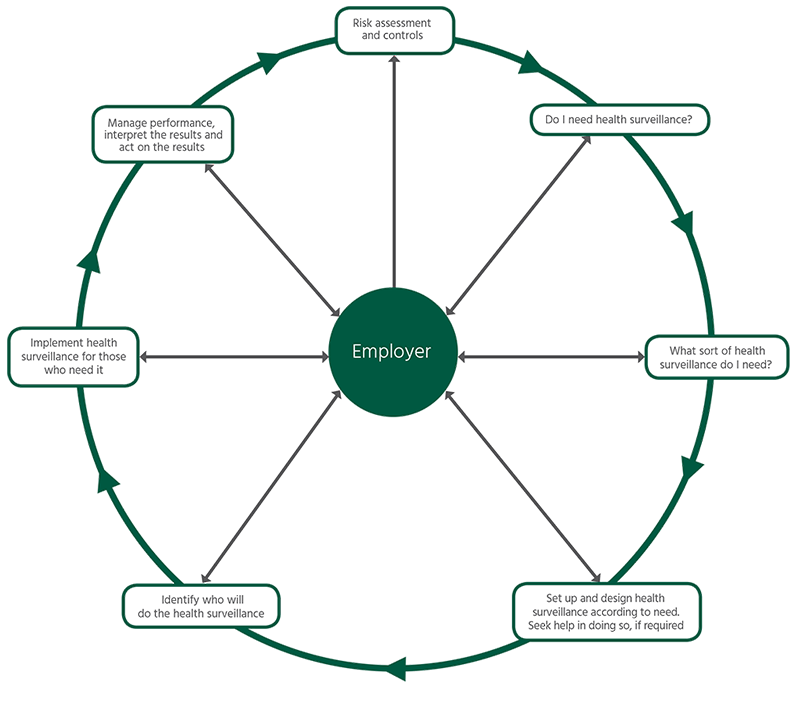
A risk assessment should be used to identify any need for health surveillance. You should not use health surveillance as a substitute for undertaking a risk assessment or using effective controls.
Health surveillance can sometimes be used to help identify where more needs to be done to control risks and where early signs of work-related ill health are detected, employers should take action to prevent further harm and protect employees.
When we put in place a health surveillance programme, we avoid blanket coverage for all employees as it can provide misleading results and waste money.
When reading this guidance remember that health surveillance is a particular legal requirement and should not be confused with:
1. Activities to monitor health where the effects from work are strongly suspected but cannot be established
2. Workplace wellbeing checks, such as promoting healthy living and fitness to work examinations eg fitness to dive, operate cranes, forklift trucks or health assessments requested by night employees
Health surveillance allows for early identification of ill health and helps identify any corrective action needed. Health surveillance may be required by law if your employees are exposed to noise or vibration, solvents, fumes, dusts, biological agents and other substances hazardous to health, or work in compressed air.

QUESTIONS? +44 (028) 4426 0105
Frequently Asked Questions?
Health surveillance is a system of ongoing health checks. These health checks may be required by law for employees who are exposed to noise or vibration, ionising radiation, solvents, fumes, dusts, biological agents, and other substances hazardous to health, or work in compressed air. Health Surveillance is not a substitute for undertaking a suitable and sufficient risk assessment and does not reduce the need to eliminate or manage health risks. All other control measures to protect workers’ health must be robust and put in place first.
The purpose of health surveillance is to maintain and protect the health and safety of your employees. This is by early detection of adverse changes to health, because of workplace exposures to health hazards.
Health Surveillance is a legal requirement and should not be confused with:
- Workplace wellbeing checks, such as promoting healthy living
- Fitness to work assessments such as fitness to drive forklift trucks or health assessments requested by night workers
Health surveillance is important to:
- Detect ill-health effects at an early stage, so you can introduce better controls to prevent them getting worse
- Provide data to help you evaluate health risks within your business
- Enable employees to raise concerns about how work affects their health
- Highlight lapses in workplace control measures, therefore providing invaluable feedback to your risk assessment
- Provide an opportunity to reinforce training and education of employees (e.g., on the impact of health effects, the importance of adhering to the controls in place, including the correct use of personal protective equipment)
Your Health Risk Assessments (HRAs) should be used to identify any need for, and type of health surveillance required. You should not use health surveillance as a substitute for undertaking a risk assessment or using effective controls.
Health surveillance may be required by law for employees who are exposed to:
· Noise or vibration
· Ionising radiation
· Asbestos, lead, or work in compressed air
· Solvents, fumes, dusts, biological agents, and other substances hazardous to health
Workers involved with asbestos, lead, compressed air, or ionising radiation require statutory medical surveillance under specific regulations, conducted by an HSE appointed doctor. The nature and frequency of these medicals are specific to the defined hazard.
The starting point in identifying the requirement for health surveillance is to conduct a risk assessment.
This will help you to identify:
· The health hazards in the workplace
· Who is at risk
· The control measures in place
· What type and level of health surveillance is required
The decision to carry out health surveillance is informed by the Business’ HRAs. Once robust controls are in place, but where some risk remains and there is likely to be harm caused to your employees, health surveillance should be implemented.
If your risk assessment is suitable and sufficient it will have identified all of the hazards in your workplace, who is at risk and the measures you can take to control the risks. You should not take a “blanket approach” to health surveillance. Health surveillance must be risk based and the risk assessment reviewed regularly to make sure it remains current and up to date.
You should strongly consider health surveillance if your employees are at risk from:
· Noise or vibration
· Ionising radiation
· Asbestos, lead, or work in compressed air
· Solvents, fumes, dusts, biological agents, and other substances hazardous to health
In the case of these particular hazards, control measures may not always be reliable, despite appropriate checking and maintenance. It, therefore makes sense to introduce health surveillance in order that any ill health is detected early.
Health surveillance is required if all the following HSE criteria are met:
· There is an identifiable disease/adverse health effect and evidence of a link with workplace exposure
· It is likely the disease/health effect may occur
· There are valid techniques for detecting early signs of the disease/health effect
· These techniques do not pose a risk to employees
Where your risk assessment has identified the requirement to implement a health surveillance programme, you will need to put into place a programme that adequately addresses the risks and potential ill-health effects your employees may be exposed to.
The HSE provides a range of industry-specific guidance and much of this includes advice on which jobs may require health surveillance and what you need to do in response. There are also a number of high hazard substances or agents where the law requires that the health surveillance programme includes statutory medical surveillance.
Statutory medical surveillance involves a medical examination, and possibly tests, by a doctor with appropriate training and experience. The doctor must have been appointed by HSE to undertake the statutory health surveillance required.
Medical surveillance is a legal requirement for the following workplace exposures:
· Particular types of work with asbestos
· Work with lead
· Work with those substances hazardous to health that are subject to Schedule 6 of the Control of Substances Hazardous to Health Regulations 2002
· Work with ionising radiation
· Work in compressed air
You will need to:
· Keep records of the health surveillance advice provided for each employee (the confidential medical records from the health surveillance are securely stored by your occupational health provider). An HSE Inspector is entitled to ask to see your employees’ health surveillance records as part of their occupational health inspection, to ensure that you are complying with the regulations
· Act upon any recommendations made by the occupational health provider about employees
· Use the results to review and, if necessary, revise your risk assessment and your plans to control risks
Analysing the results of your health surveillance for groups of workers can give you an insight into how well your risk control arrangements are working.
As a rule, keep individual health records for those employees for as long as they are under health surveillance. Some regulations, for example, the Control of Substances Hazardous to Health (COSHH) and those for lead, asbestos, ionising radiation, and compressed air, require that records should be retained for much longer (up to 50 years) as ill health effects might not become apparent until a long time after exposure.
Please see link to HSE’s health Surveillance website for further information. https://www.hse.gov.uk/health-surveillance/overview.htm